Thank you for writing to us. One of our executive will reach back to you through your submitted medium. In case there’s an urgency, feel free to connect over WhatsApp for faster response.
Prefer calling? Dial +9108048066859 (International callers) or 08048066859 (Indian callers).
Depending on the scale and purpose, pasta and macaroni machines come in various types. Below are the most common ones:
A. Manual Pasta Machines
These are small machines operated by hand, ideal for domestic or small commercial setups. They are suitable for fresh pasta but not for large-scale or industrial production.
Features:
Compact and easy to use
Ideal for cafes or restaurants
Limited production capacity
B. Semi-Automatic Pasta Making Machines
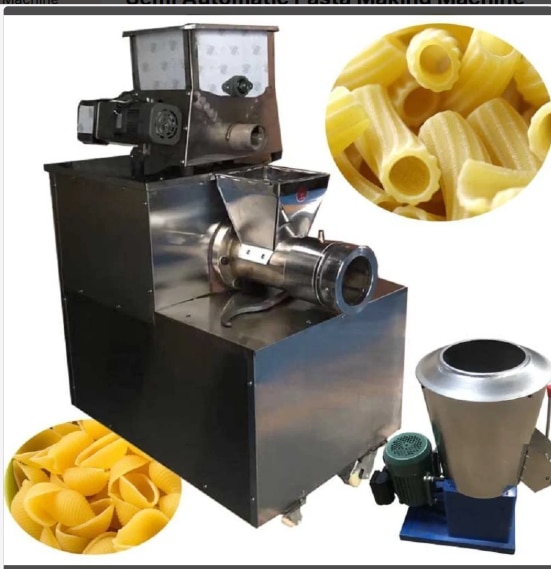
These machines combine manual and automatic operations. The operator feeds ingredients manually, while extrusion and cutting are automated.
Features:
Medium production capacity
Lower initial investment
Easier to maintain
Pasta is a major staple in many cuisines around the world. Whether it’s spaghetti, penne, fusilli, macaroni, or other shapes, pasta has a broad market: retail, food service, restaurants, packaged goods. As consumer demand has grown, many producers move from artisanal/manual production toward mechanized production—but full automation can be expensive. Here semi‑automatic pasta making machines offer a sweet‑spot: partial automation that reduces labour, ensures consistency, but without the full capital cost and complexity of automatic/turn‑key lines.
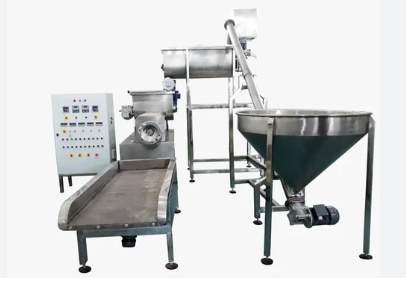
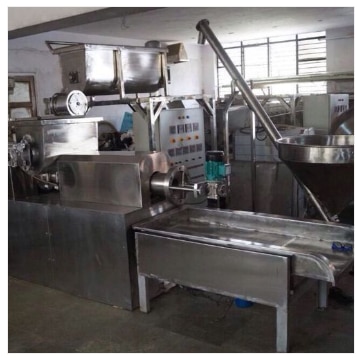
A semi‑automatic pasta making machine is a machine (or integrated set of machines) that automates key processes in pasta production (mixing, extrusion, shaping) but still requires some manual input, supervision, or manual feeding/handling. These machines are used by small to medium‑scale pasta producers, restaurants, caterers, or companies wanting flexibility and lower investment, but still require capacity above what pure manual production allows.
A Fully Automatic Pasta Making Machine is an industrial-grade equipment used to manufacture pasta on a commercial scale. Unlike semi-automatic or manual machines, these machines perform every step automatically – mixing, kneading, extruding, cutting, drying (if included), and packaging (if part of the line).
Fully automatic pasta machines are designed for food manufacturing companies, restaurants with bulk production needs, cloud kitchens, and pasta production plants. They are capable of producing various pasta shapes such as penne, fusilli, spaghetti, macaroni, farfalle (bow-tie), and shells.
2. Working Principle of a Fully Automatic Pasta Making Machine
The process of pasta production in a fully automatic machine typically involves the following steps:
Flour Feeding & Mixing – High-quality wheat flour, semolina, or other desired ingredients are fed into the hopper. The machine mixes the flour with water (and other ingredients like eggs if required) to form a dough.
Kneading – The machine kneads the dough to the perfect consistency, ensuring proper gluten development and elasticity.
Extrusion & Shaping – The dough is forced through interchangeable dies or molds that determine the shape of the pasta.
Cutting & Portioning – The extruded pasta is cut into uniform lengths by a rotating blade system.
Pre-Drying / Drying (Optional) – Some models include drying tunnels or systems to remove excess moisture from pasta, improving shelf life.
Collection / Packaging – The finished pasta is collected and can be packed manually or using an automated packing system.
This entire process is controlled via a PLC-based control panel or touchscreen interface, allowing operators to set production parameters, monitor operations, and ensure consistent output.