

Gemini said
The evolution of pasta from a labor-intensive, hand-rolled craft to a precision-engineered kitchen staple is a testament to our obsession with the perfect "al dente" bite. Whether it’s a heavy-duty Italian hand-crank or a high-tech automated extruder, the pasta making machine has democratized the art of fresh dough.
1. The Anatomy of Pasta Machines
Before diving into the mechanics, it is essential to distinguish between the two primary categories of machines: Rollers and Extruders.
Manual Roller Machines (The Traditionalist)
The manual roller is the iconic stainless-steel device often seen clamped to a wooden countertop. It operates on a simple principle: two parallel rollers pull the dough through, progressively narrowing the gap to create a thin sheet (sfoglia).
The Adjustment Knob: Controls the distance between rollers, usually indexed from 0 (widest) to 9 (thinnest).
The Cutter Attachment: Most manual machines come with a dual-cutter head for Fettuccine and Tagliolini.
The Hand Crank: Provides the torque required to process dense, unleavened dough.
Electric Extrusion Machines (The Modernist)
Extruders work like a sophisticated play-dough factory. Instead of rolling sheets, they use an internal screw (auger) to force dough through a shaped "die" or disc.
Versatility: These machines can produce shapes impossible for rollers, such as Rigatoni, Penne, and Macaroni.
Automation: High-end models like those from Philips or Marcato mix, knead, and extrude the pasta in under 10 minutes.
2. The Science of the Dough
A pasta machine is only as good as the dough fed into it. The physics of pasta involves the development of gluten networks.
Ingredients and Hydration
The standard ratio for Italian egg pasta is 100g of flour to 1 large egg. However, the machine’s efficiency depends on the hydration level.
Roller Dough: Needs to be more elastic and slightly drier so it doesn't stick to the steel.
Extruder Dough: Needs a "breadcrumb" texture. If the dough is too wet, it will clogs the die; too dry, and it won't bind.
Flour Types
| Flour Type | Protein Content | Best For... |
|---|---|---|
| 00 Flour | ~11-12% | Silky, tender egg pasta (Tagliatelle) |
| Semola (Semolina) | ~13-14% | Hearty, coarse pasta (Orecchiette, Fusilli) |
| All-Purpose | ~10-11% | A reliable, accessible middle ground |
3. The Process: From Flour Mound to Plate
Using a pasta machine is a rhythmic, three-stage process: Kneading, Lamination, and Cutting.
Stage 1: The Initial Roll
After resting the dough for at least 30 minutes (to relax the gluten), you pass it through the widest setting. At this stage, the dough looks ragged.
Stage 2: Lamination
This is the secret to professional-grade pasta. You fold the dough into thirds (like a letter) and pass it through the widest setting again. Repeating this 5–8 times aligns the protein strands, resulting in a "snappy" texture that holds up in boiling water.
Stage 3: The Thinning
Once laminated, you click the dial down one notch at a time.
Pro-Tip: Never skip a number. Jumping from setting 1 to 4 will tear the dough and potentially strain the machine's internal gears.
[Image showing the stages of pasta thinning from thick sheet to translucent sheet]
4. Maintenance and Longevity
The cardinal rule of pasta machines is: Never use water.
Because these machines are built with high-carbon steel or chrome-plated components, water leads to rust and causes leftover flour to turn into a "cement" inside the gears.
Cleaning: Use a dry pastry brush or a toothpick to flick away dried dough.
Storage: Keep the machine in a dry place. If you use it frequently, a drop of food-grade mineral oil on the outer gears every few months will keep the motion fluid.
5. Industrial vs. Home Machines
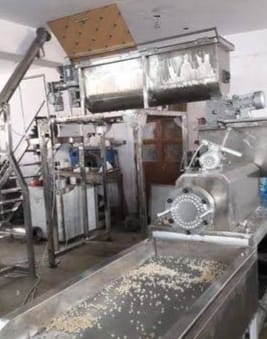
While the home cook focuses on flavor, industrial pasta production focuses on thermal stability. In large-scale manufacturing, the friction of extrusion can heat the dough, potentially "cooking" the protein before it hits the water. Industrial machines use water-cooled jackets around the extrusion chambers to keep the dough at a constant temperature, ensuring the structural integrity of the pasta.
For the home cook, the choice often boils down to the Marcato Atlas 150 (the "Ferrari" of manual rollers) or an electric attachment for a stand mixer. The manual route offers more control and a better "feel" for the dough, while electric versions are a godsend for those cooking for large families.
6. Common Troubleshooting
Dough is Tearing: This usually means the dough is too dry or you haven't rested it long enough. Let it sit under an inverted bowl for 15 minutes.
Dough is Sticking to Rollers: Your hydration is too high. Dust the sheets lightly with semolina flour before passing them through.
The "Wavy" Edge: If the edges of your pasta sheet look ruffled, the dough is being forced through a gap that is too narrow too quickly. Slow down the cranking speed.
Conclusion
Investing in a pasta machine is an investment in a culinary ritual. It transforms a humble mixture of flour and eggs into a versatile canvas for sauces. Whether you are chasing the paper-thin transparency of a Piedmontese Tajarin or the robust ridges of a Rigatoni, the machine is the bridge between raw ingredients and an authentic Italian experience.