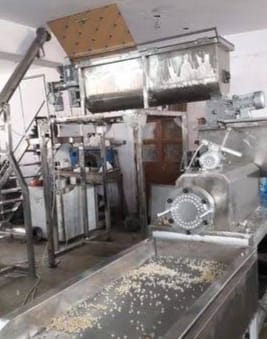


The Industrial Art of Pasta: An In-Depth Look at Macaroni Making Machines
The transition of pasta from a handmade artisanal craft to a global dietary staple is largely thanks to the evolution of the Macaroni Pasta Making Machine. Whether it’s the nostalgic elbow shape in a bowl of mac and cheese or the sophisticated ridges of penne, these machines combine mechanical engineering, thermodynamics, and food science to produce consistent, high-quality products at an incredible scale.
1. The Core Components of a Pasta Line
Modern industrial macaroni machines are typically integrated into a continuous production line. Unlike manual home extruders, these systems are designed to operate 24/7 with minimal human intervention.
The Dosing System: Precision begins with the raw materials. High-tech sensors ensure the correct ratio of semolina flour (derived from durum wheat) to water. Some machines also incorporate dosing for eggs, vegetable juices (for color), or vitamins.
The Vacuum Mixer: This is a critical stage. Mixing the dough under a vacuum prevents the oxidation of pigments, preserving the bright amber-yellow color of the semolina. It also eliminates air bubbles, which would otherwise cause the pasta to become brittle and break during the drying process.
The Extrusion Screw: Often referred to as the "heart" of the machine, this heavy-duty stainless steel screw pushes the dough forward with immense pressure.
The Die and Cutter: The die is a metal plate with shaped holes (inserts) through which the dough is forced. For macaroni, these are tubular. A rotating blade at the face of the die cuts the pasta to the desired length.
2. The Extrusion Process: Turning Dough into Shape
The magic of the macaroni machine happens during extrusion. It is not just about pushing dough through a hole; it is about managing heat and pressure.
As the dough is compressed by the extrusion screw, friction generates heat. If the dough gets too hot (above $50^\circ\text{C}$ to $60^\circ\text{C}$), the gluten structure can break down, leading to "mushy" pasta when cooked. To prevent this, industrial machines feature water-cooled jackets around the extrusion cylinder to maintain a constant, optimal temperature.
The Role of the Die
The die determines the texture of the macaroni.
Teflon Dies: These produce smooth, shiny pasta that moves through the machine quickly.
Bronze Dies: Traditional and premium pasta brands use bronze dies. These create a rougher, porous surface on the macaroni, which is scientifically proven to help sauces "stick" to the pasta better.
3. The Science of Drying
If you were to package macaroni immediately after it leaves the cutter, it would mold within days. The drying stage is the most time-consuming and technically demanding part of the process.
Modern machines use Multi-Stage Drying:
Pre-Drying (Trabatto): The fresh pasta (which has about 30% moisture) is vibrated or shaken under hot air to harden the surface quickly. This prevents the pieces from sticking together.
Main Drying: The pasta moves through long tunnels on tiered conveyor belts. Here, the moisture content is slowly reduced to approximately 12.5%.
Stabilization: If the pasta dries too fast, the outer layer shrinks faster than the core, causing "checking" or internal cracks. The machine must carefully manage humidity to ensure the pasta remains structurally sound.
4. Technical Specifications and Varieties
When selecting a macaroni making machine, manufacturers look at several key performance indicators:
| Feature | Small-Scale / Lab | Industrial Line |
| Production Capacity | 10 – 50 kg/hr | 500 – 2,000+ kg/hr |
| Material | Stainless Steel 304 | Stainless Steel 304/316 |
| Power Consumption | 3 – 5 kW | 50 – 150 kW |
| Automation | Manual/Semi-Auto | Fully Automated PLC Control |
5. Maintenance and Hygiene
Because pasta is a food product, the machine must adhere to strict HACCP (Hazard Analysis and Critical Control Points) standards.
CIP (Clean-In-Place): High-end machines feature automated cleaning systems that flush the internal components with sanitizing solutions.
Stainless Construction: All parts in contact with food are made of food-grade stainless steel to prevent corrosion and bacterial growth.
Die Maintenance: Dies must be cleaned in ultrasonic baths to remove microscopic dough residue that could harden and ruin the shape of the next batch.
6. The Future: Innovation in Pasta Tech
The industry is currently seeing a shift toward Sustainability and Nutrition.
Energy Recovery: Newer drying tunnels are designed to capture and reuse the heat generated during the process, significantly lowering the carbon footprint.
Alternative Flours: Machines are being recalibrated to handle non-traditional ingredients like lentil flour, chickpea flour, and gluten-free blends. These "non-plastic" doughs require different screw speeds and extrusion pressures because they lack the elastic gluten found in wheat.
AI Integration: Smart sensors now monitor the dough's viscosity in real-time, automatically adjusting water or flour intake to compensate for changes in ambient humidity or grain quality.
Summary
The macaroni pasta making machine is a marvel of industrial balance. It takes simple ingredients—flour and water—and uses high-pressure physics and controlled dehydration to create a shelf-stable product enjoyed by millions. From the precision of the vacuum mixer to the delicate moisture control of the drying racks, every step is designed to ensure that when you drop those macaroni elbows into boiling water, they hold their shape and deliver the perfect al dente bite.