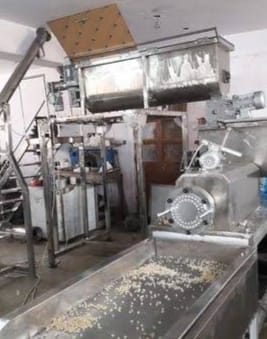


The production of macaroni and other pasta shapes at an industrial scale is a marvel of food engineering. From a simple mixture of semolina and water to the dried, shelf-stable product in your pantry, the Pasta Macaroni Making Machine (or extrusion line) handles everything with clinical precision.
Below is an in-depth look at how these machines function, the technology behind them, and the components that make high-volume pasta production possible.
1. The Core Components of a Macaroni Machine
A professional-grade macaroni production line isn't just one machine; it’s a series of integrated systems.
A. The Dosing and Mixing System
Everything starts with the raw materials. High-quality macaroni typically uses Durum Wheat Semolina.
The Hopper: Stores the flour/semolina.
Dosing Pumps: These ensure that the ratio of water to flour is exact—usually around 25-30% moisture content.
The Pre-mixer: A high-speed centrifugal mixer that ensures every grain of flour is hydrated without forming large lumps.
B. The Vacuum Extrusion System
This is the "heart" of the machine. The dough is moved into a vacuum chamber before being pushed through the screw.
Why Vacuum? Removing air from the dough prevents oxidation (which preserves the bright yellow color) and ensures the pasta is dense and free of tiny air bubbles, which would cause it to break during boiling.
C. The Extrusion Screw and Die
The screw (or auger) pushes the dough toward the Die. The die is a metal plate with holes shaped like macaroni.
Teflon vs. Bronze Dies: Industrial machines use Teflon-lined dies for a smooth, shiny finish. Artisanal-style machines use Bronze dies, which create a rougher surface that helps sauce stick to the pasta.
2. The Step-by-Step Production Process
Step 1: Raw Material Preparation
The semolina is sifted to remove impurities. If the recipe calls for eggs or vegetable purees (like spinach or tomato), these are injected at this stage.
Step 2: Extrusion and Shaping
The dough is forced through the die. As the macaroni emerges, a rotating cutter at the face of the die spins at a specific speed.
Slow spin: Results in long pasta (like Penne or long Macaroni).
Fast spin: Results in short-cut shapes (like Elbow Macaroni).
Step 3: The Pre-Drying (Trabatto)
Freshly extruded pasta is very sticky. It immediately enters a shaker called a Trabatto. It uses hot air and vibration to dry the surface of the pasta quickly, preventing the pieces from sticking together as they move to the main dryer.
Step 4: Final Drying (The Critical Phase)
This is the longest part of the process. If you dry pasta too fast, it cracks (checks). If you dry it too slowly, it can mold or sour.
Multi-stage Drying: The pasta travels through a long tunnel on conveyor belts. The temperature and humidity are strictly controlled using sensors.
Duration: Industrial drying can take anywhere from 4 to 10 hours depending on the thickness of the macaroni.
Step 5: Cooling and Packaging
Once dried to about 12.5% moisture, the pasta is cooled to room temperature. It is then sent to vertical packaging machines that weigh the pasta and seal it into bags.
3. Technical Specifications to Consider
If you are looking to acquire or study these machines, here are the vital statistics:
| Feature | Small-Scale / Lab | Industrial Line |
| Production Capacity | 15–50 kg/hour | 500–2,000+ kg/hour |
| Power Consumption | 5–10 kW | 50–150+ kW |
| Material | Stainless Steel 304 | Stainless Steel 304/316 |
| Automation | Manual/Semi-Auto | Fully PLC Controlled |
| Space Required | 20–50 sq. meters | 200–1,000+ sq. meters |
4. Why Invest in an Automatic Macaroni Machine?
Precision and Consistency
Unlike manual pasta making, a machine ensures that every single noodle has the same wall thickness. This means they all cook at the same rate, which is the hallmark of a quality brand.
Labor Efficiency
Modern lines are controlled by PLC (Programmable Logic Controllers). A single operator can monitor the entire process from a touchscreen, from the initial flour intake to the final packaged bag.
Versatility
By simply changing the Die, the same machine can produce:
Elbow Macaroni
Fusilli (Spirals)
Shells (Conchiglie)
Rigatoni
Star shapes (for soup)
5. Maintenance and Hygiene
Because pasta involves water and flour, hygiene is paramount to prevent bacterial growth.
CIP (Clean-In-Place): Many high-end machines feature self-cleaning cycles for the mixing vats.
Stainless Construction: All food-contact parts must be food-grade stainless steel to prevent rust and ensure easy sanitization.
Die Cleaning: Dies must be removed and cleaned in ultrasonic baths to remove hardened dough from the intricate shapes.
6. Common Troubleshooting in Production
White Spots: Usually caused by "white caps" in the semolina or improper hydration in the mixer.
Checking (Cracking): This happens when the drying phase is too aggressive, causing the outer layer to shrink faster than the core.
Cloudy Cooking Water: This indicates that the starch wasn't properly contained, often due to poor extrusion pressure or low-quality flour.
Summary
The modern Pasta Macaroni Making Machine is a feat of thermodynamics and mechanical engineering. By balancing pressure, heat, and airflow, these systems turn simple ingredients into one of the world's most beloved staples. Whether you are looking at a small boutique setup or a massive 24-hour factory line, the principles remain the same: Precision, Vacuum, and Controlled Drying.