
1. Introduction
The global shift toward sustainable and environmentally responsible packaging has given rise to several innovative alternatives to single-use plastics. Among these innovations, edible crockery—including edible tea cups—has emerged as a promising solution. Edible cups eliminate packaging waste entirely, providing users with the dual experience of enjoying their drink and consuming the cup itself, or disposing of it without harming the environment. The increasing popularity of eco-friendly café culture, zero-waste restaurants, and sustainable event catering has further strengthened the demand for Edible Tea Cup Making Machinery.
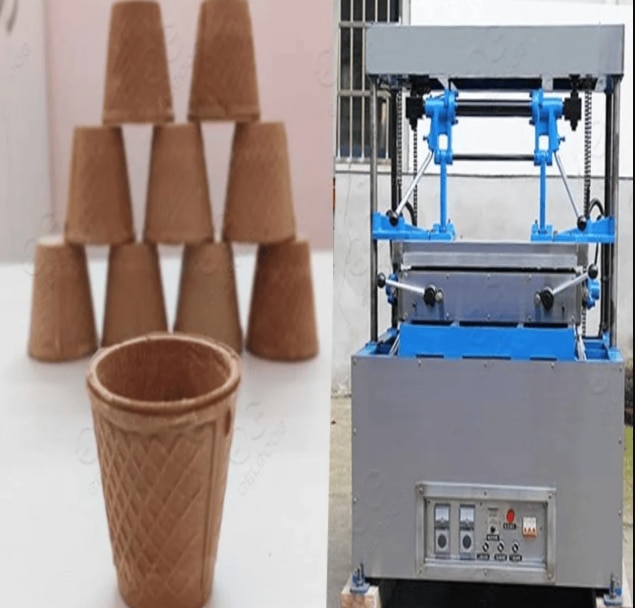
Edible tea cup making machines are specialized industrial or semi-industrial systems designed to mass-produce robust, food-grade, consumable cups made from various edible ingredients such as wheat flour, millet flour, rice flour, chocolate, sugar, gelatin, and other biodegradable organic materials. These machines combine principles of food processing, thermoforming, baking technology, molding, and mechanical automation to manufacture consistent, safe, and durable edible cups suitable for serving hot beverages.
This comprehensive guide explores all aspects of edible tea cup making machinery—from core technology and materials to manufacturing workflows, equipment configurations, quality control, business prospects, and market trends.
2. What Are Edible Tea Cups?
Edible tea cups, also known as eco cups, are biodegradable food-grade cups made from natural ingredients. Their key characteristics include:
Edibility: Can be safely consumed post-use.
Heat Resistance: Withstand temperatures of 80–90°C for 20–40 minutes depending on formulation.
Structural Integrity: Maintain shape long enough to finish drinking.
Flavor Varieties: Plain, chocolate, vanilla, coffee, millet, multi-grain, etc.
Eco-Friendly Disposal: Completely compostable if not consumed.
Custom Shapes and Sizes: Espresso cups, tea cups, coffee mugs, shot glasses.
These characteristics set the foundation for the machinery required to produce them.
3. Industry Need for Edible Tea Cup Machines
The demand for edible cup production equipment arises from:
Plastic Ban Regulations: Many regions have banned single-use plastics.
Event Industry Growth: Eco-friendly disposables for events, weddings, conferences.
Café and Restaurant Sustainability: Green branding and reduced waste.
Export Market Expansion: Europe and North America seeking sustainable packaging.
Entrepreneurship Opportunities: Low competition and high demand niche.
Therefore, companies and startups are increasingly investing in machinery that can produce edible cups at scale.
4. Working Principle of Edible Tea Cup Making Machinery
Edible cup making machines utilize a combination of:
Batter/Dough Preparation
Automatic Cup Molding
Heat Pressing or Baking
Drying and Hardening
De-molding
Finishing and Packaging
The core principle involves forcing prepared edible material into cup molds where heat and pressure transform it into a hardened, cup-shaped form.
5. Major Types of Edible Tea Cup Making Machines
5.1 Semi-Automatic Machines
Ideal for small businesses or startups.
Features:
Manual batter feeding.
Semi-automatic molding.
Lower energy consumption.
Operate on single-phase power.
Output: 100–400 cups/hr.
5.2 Fully Automatic Machines
Built for medium to large-scale production.
Features:
Automated feeding, molding, baking, and ejection.
PLC-based control systems.
Servo-driven precision mechanics.
Output: 800–2000+ cups/hr.
5.3 Rotary Edible Cup Making Machines
These use a rotary thermoforming setup.
Features:
Continuous cup production.
Multi-head molds.
High speed and uniformity.
Output: 1500–5000 cups/hr.
5.4 Conveyor-Based Baking Setups
Used for large-scale edible cup factories.
Features:
Continuous conveyor drying.
Multiple heating zones.
Ideal for high heat-resistant cups.
Output: Scalable to 50,000