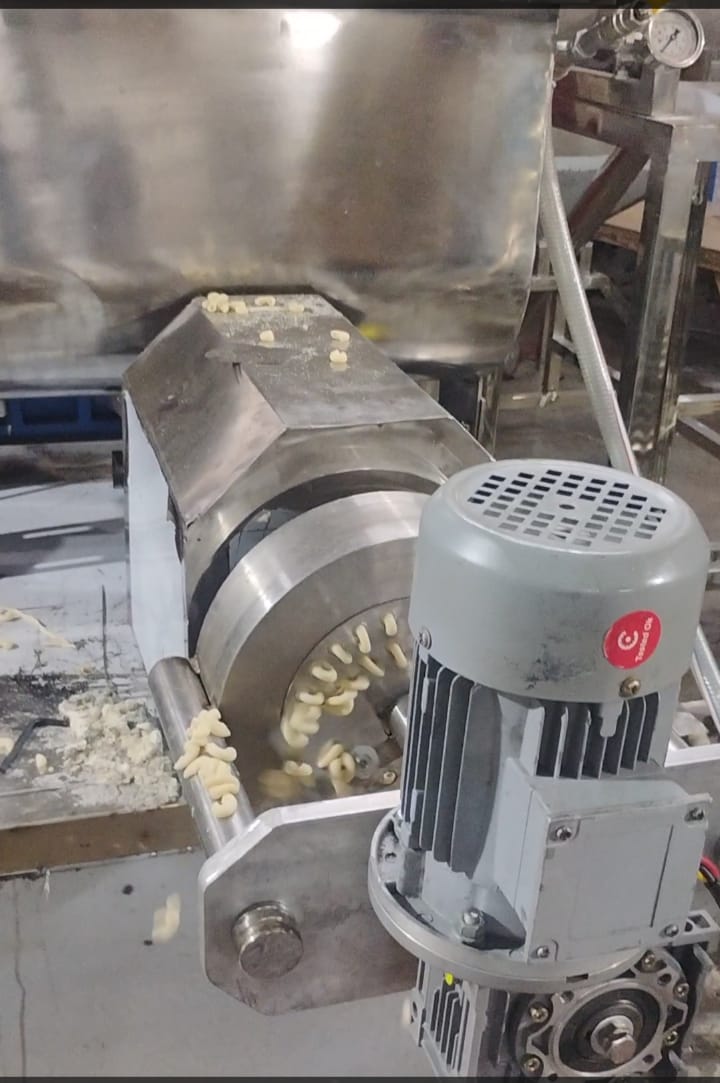


The pasta and macaroni manufacturing industry has evolved from a traditional craft into a high-tech, automated science. Modern Pasta Macaroni Making Machines are the heart of this transformation, allowing producers to achieve consistent quality, high output, and intricate shapes that were once impossible to scale.
Whether you’re looking to start a small boutique pasta brand or an industrial-scale plant, understanding the machinery is the first step toward a "perfectly al dente" business.
1. The Core Technology: How it Works
At its simplest, a pasta machine takes semolina flour and water and transforms them into a specific shape via extrusion. However, industrial machines involve much more than just "pushing dough through a hole."
The Mixing and Kneading Stage
The process begins in the vacuum mixer. Standard mixers can leave air bubbles in the dough, which results in brittle pasta that breaks during boiling. Modern machines use vacuum mixing technology to remove air, ensuring the dough is dense, elastic, and has that signature translucent yellow color.
The Extrusion System
This is where the magic happens. The dough is pushed through a die (a perforated plate).
Teflon Dies: Produce a smooth, shiny pasta surface.
Bronze Dies: Create a rough, porous texture. This is preferred for premium pasta because the rough surface allows sauces to "stick" better to the macaroni.
2. Key Components of a Production Line
A complete production line is a series of interconnected machines, each performing a specialized task:
| Component | Function | Why it matters |
| Dosing System | Measures flour and water ratios. | Ensures consistency in every batch. |
| Extruder | Shapes the dough under high pressure. | Determines the variety (penne, fusilli, etc.). |
| Pre-Dryer (Trabatto) | Quickly dries the surface of the pasta. | Prevents the pasta from sticking together. |
| Drying Tunnel | Removes moisture slowly over several hours. | Prevents cracking and ensures long shelf life. |
| Cooling System | Brings pasta to room temperature. | Prepares it for immediate packaging. |
3. Types of Pasta Machines
Depending on your target market, you’ll choose between three main categories:
A. Single-Screw Extruders
Commonly used for standard macaroni and short pasta. They are cost-effective and reliable for high-volume production where the dough consistency is relatively uniform.
B. Twin-Screw Extruders
These are the "heavy lifters." They provide better mixing and can handle different types of raw materials, such as gluten-free flours (rice, corn, or lentil). They offer superior control over the cooking and shearing of the dough.
C. Fresh vs. Dry Pasta Machines
Fresh Pasta Machines: Focus on forming and light pasteurization; the product is meant for refrigeration.
Dry Pasta Lines: Much larger and more expensive due to the massive drying chambers required to bring moisture levels down to roughly 12.5%.
4. The Critical Importance of Drying
If you are making dry macaroni, the Drying Stage is actually more important than the shaping stage. If pasta dries too fast, the outside hardens while the inside stays moist, leading to "checking" (cracks). If it dries too slowly, mold can develop.
Modern machines use PLC (Programmable Logic Controller) systems to manage a delicate balance of temperature and humidity, often moving through multiple "zones" to ensure the starch structure is perfectly preserved.
5. Maintenance and Hygiene
Because pasta involves water and flour, it is a breeding ground for bacteria if not handled correctly. Industrial machines are now built with:
Food-grade Stainless Steel (304 or 316): To prevent corrosion.
CIP (Clean-in-Place) Systems: Automated washing cycles for the internal parts.
Quick-Change Dies: Allowing operators to switch from macaroni to rigatoni in minutes without heavy tools.
6. Technical Specifications to Look For
When evaluating a machine, keep these metrics in mind:
Production Capacity: Measured in kg/h (kilograms per hour). Small units do 30–50 kg/h; industrial lines do 500–2,000 kg/h.
Power Consumption: Extruders and dryers are energy-intensive. Look for machines with high-efficiency motors.
Automation Level: Semi-automatic machines require manual tray loading; fully automatic lines are "untouched by human hands" until the bag is sealed.
Summary
The "perfect" pasta machine isn't just about speed; it's about the precision of the vacuum, the quality of the bronze die, and the sophistication of the drying cycle. As global demand for diverse pasta types—including whole-wheat and protein-based varieties—continues to grow, investing in versatile, automated machinery is the key to staying competitive.