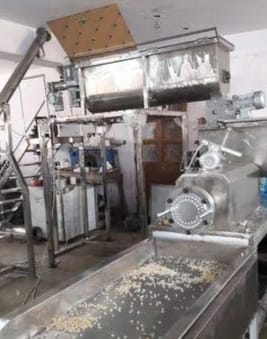


The production of macaroni—that iconic, hollow, elbow-shaped pasta—has evolved from a labor-intensive kitchen craft into a highly sophisticated industrial process. A modern Pasta Macaroni Making Machine is a marvel of food engineering, designed to handle everything from dough mixing to final shaping with surgical precision.
Whether you are looking to start a small boutique pasta brand or scale up to high-volume industrial production, understanding the mechanics, technology, and components of these machines is essential.
1. The Core Technology: Single-Screw vs. Twin-Screw Extrusion
At the heart of any macaroni machine is the extruder. Most macaroni machines use single-screw extrusion technology combined with vacuum systems.
Vacuum System: This is critical. By removing air bubbles from the dough during mixing and extrusion, the machine ensures the pasta is dense, translucent, and has that signature "snap" when dry. Without a vacuum, the macaroni would be brittle and cloudy.
The Screw and Barrel: Usually made from high-grade stainless steel or nitrided steel, the screw pushes the dough forward while applying specific pressure and temperature controls to ensure consistent gelatinization of the starch.
2. The Production Workflow
An industrial macaroni line isn’t just one machine; it’s a synchronized symphony of several components working in tandem.
Step A: Raw Material Mixing
The process begins with Semolina (durum wheat flour) and water. High-end machines feature automatic dosing systems that ensure the moisture content stays precisely around 25% to 30%.
Step B: Extrusion and Shaping
As the dough reaches the end of the barrel, it is forced through a die. For macaroni, these dies are circular with a pin in the center to create the hollow tube.
The Cutter: A high-speed rotating blade sits flush against the die. By adjusting the speed of this blade, you determine the length of the macaroni (e.g., short-cut elbow vs. long penne).
Step C: Pre-Drying (The Shaker)
Freshly extruded macaroni is sticky. The "shaker" or pre-dryer uses vibrating trays and hot air to dry the surface of the pasta immediately, preventing the pieces from clumping together.
Step D: The Drying Tunnel
This is the longest part of the process. The pasta travels through a multi-layer conveyor belt system where temperature and humidity are strictly controlled. If pasta dries too fast, it cracks; too slow, and it spoils.
3. Key Components of the Machine
| Component | Function | Material/Detail |
| Flour Mixer | Blends flour, water, and additives. | Stainless Steel 304 |
| Screw Extruder | Compresses and shapes the dough. | Alloy steel with cooling jacket |
| Cooling System | Regulates barrel temperature to prevent "cooking" the dough. | Water-circulating pipes |
| Rotary Cutter | Cuts the pasta to specific lengths. | Variable frequency speed control |
| Hoist/Conveyor | Transfers pasta between stages. | Food-grade PVC or Mesh |
4. Technical Specifications to Consider
If you are evaluating a machine for purchase, these are the "stats" that matter:
Production Capacity: Ranges from 100kg/h for small startups to over 2,000kg/h for massive factories.
Power Consumption: Industrial lines usually require 3-phase power (380V/50Hz) and can consume anywhere from 40kW to over 150kW depending on the drying method (electric vs. steam).
Automation Level: Modern machines use PLC (Programmable Logic Controller) touchscreens. This allows operators to save "recipes"—ensuring that the settings for Macaroni are different from those for Fusilli at the press of a button.
5. Why the "Die" Matters
The "Die" is the mold that determines the shape. For macaroni, manufacturers often use Teflon-lined dies or Bronze dies.
Teflon Dies: Produce a smooth, shiny pasta that is popular in grocery stores.
Bronze Dies: Create a rougher, more porous surface. This is the "premium" choice because the rough texture helps pasta sauce "stick" to the macaroni better.
6. Maintenance and Food Safety
Because these machines handle "wet" dough, hygiene is paramount.
CIP (Clean-In-Place): High-end models have features that allow for easier cleaning of the screw and barrel.
Stainless Construction: All parts in contact with food must be SUS304 stainless steel to prevent corrosion and meet international food safety standards (CE/FDA).
7. The Business Advantage
Investing in an automated macaroni making machine offers several benefits:
Consistency: Every piece of macaroni is identical in weight and texture.
Labor Efficiency: A fully automated line requires only 1–2 operators to monitor the PLC and pack the finished product.
Versatility: By simply changing the die and the cutter speed, the same machine can produce shells, fusilli, rigatoni, and stars.