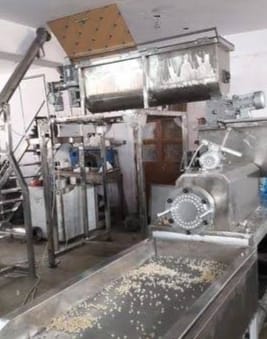


If you’re looking to scale up from a hand-cranked pasta cutter to an industrial powerhouse, understanding the mechanics of a Macaroni Pasta Making Machine is essential. Whether it’s for a boutique pasta shop or a high-output factory, these machines are marvels of food engineering.
1. The Core Philosophy of Pasta Extrusion
At its heart, a macaroni machine is an extruder. Unlike traditional rolled pasta (like fettuccine), macaroni requires high pressure to force dough through a shaped disk, known as a die. This process allows for the creation of hollow tubes, ridges, and complex "short" shapes that hold sauces perfectly.
2. Key Components of the Machine
To produce consistent, high-quality pasta, several systems must work in perfect synchronization:
The Mixing Hopper: This is where the magic begins. Flour (usually Semolina) and water (sometimes egg or spinach juice) are combined. Modern machines use vacuum mixing to prevent air bubbles, resulting in a more translucent, stronger pasta.
The Extrusion Screw (Auger): This large, stainless steel screw pushes the dough forward. In high-end models, this section is water-cooled.
Why cooling matters: The friction of the dough generates heat. If the dough exceeds $50°C$, the protein structure can break down, leading to mushy pasta.
The Die (The Architect): Usually made of bronze or Teflon.
Bronze Dies create a rough, porous surface that "grabs" sauce.
Teflon Dies create a smooth, shiny pasta that is easier to dry and has a longer shelf life.
The Rotary Cutter: A high-speed blade that spins across the face of the die. By adjusting the speed of this blade, you determine the length of the macaroni—from tiny ditalini to long penne.
3. The Production Process: Step-by-Step
Phase I: Dosing and Mixing
Precision is everything. Industrial machines use gravimetric feeders to ensure the water-to-flour ratio is exact. Usually, the moisture content is kept around 30-32%.
Phase II: Compression
As the screw turns, the dough is compressed into a dense, homogenous mass. This is where the gluten network is developed, giving the macaroni its "al dente" bite.
Phase III: Shaping and Cutting
The dough is forced through the die. As the macaroni emerges, the rotary cutter snips it. For curved macaroni (elbows), the die is designed to extrude one side slightly faster than the other, causing the tube to curl naturally.
Phase IV: Pre-Drying (The Shaker)
Freshly cut pasta is sticky. It immediately enters a "trabatto" or shaker pre-dryer. This uses hot air and vibration to create a "skin" on the pasta so it doesn't clump together.
4. Technical Specifications to Consider
When shopping for a machine, the "1000-word" depth usually involves comparing these metrics:
| Feature | Small Scale (Artisanal) | Large Scale (Industrial) |
| Output Capacity | 5 – 20 kg/hour | 200 – 1000+ kg/hour |
| Cooling System | Manual/Passive | Automatic Water-Jacketed |
| Material | Stainless Steel/Brass | Food-grade 304/316 Stainless |
| Control | Manual Switches | PLC Touchscreen |
5. Maintenance and Hygiene
Because pasta dough is a biological product, sanitation is paramount.
Die Cleaning: Most operators use a "die washer" or ultrasonic cleaner to remove hardened dough from the intricate crevices of the bronze molds.
Screw Extraction: The auger must be removed daily to ensure no dough remains to ferment or grow mold in the "dead zones" of the barrel.
6. The Evolution: Vacuum Technology
The gold standard in modern macaroni production is Vacuum Extrusion. By removing air from the mixing chamber, the machine eliminates "micro-bubbles."
The result: A deeper yellow color, better cooking stability, and a much longer shelf life because there is less oxygen trapped inside the pasta to oxidize the fats and pigments.
Summary of the "Macaroni Path"
From flour bin to drying rack, the macaroni making machine is a bridge between culinary art and mechanical precision. By controlling the pressure, temperature, and cut speed, manufacturers can create thousands of variations of the humble noodle.