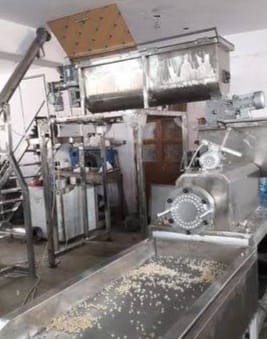


The production of macaroni, vermicelli, and various pasta shapes has evolved from a labor-intensive kitchen craft into a sophisticated industrial process. At the heart of this transformation is the Macaroni Vermicelli Pasta Making Machine, a versatile piece of engineering designed to handle everything from dough mixing to final extrusion.
This guide explores the technical specifications, operational mechanisms, and business advantages of investing in a high-quality pasta production line.
1. Introduction to Pasta Extrusion Technology
Modern pasta machines generally utilize single-screw or twin-screw extrusion technology. These machines are designed to process raw materials—typically semolina (durum wheat), all-purpose flour, or even alternative grains like corn and rice—into consistent shapes.
The primary goal of the machine is to create a product that maintains its structural integrity during boiling while offering the desired "al dente" texture.
2. The Production Process: Step-by-Step
A complete pasta making line is an integrated system where several components work in harmony.
A. Mixing and Dosing
The process begins in the High-Speed Mixer. Here, flour is combined with water (and sometimes eggs or spinach puree for color). The moisture content is critical; typically, pasta dough requires a moisture level of 25% to 30%.
Vacuum Mixing: High-end machines feature vacuum mixing chambers. By removing air from the dough, the machine prevents oxidation and ensures the final pasta has a vibrant yellow color and no tiny air bubbles, which can cause breakage.
B. Extrusion and Shaping
Once the dough is uniform, it is pushed through the Extruder.
The Screw: A rotating screw compresses the dough and pushes it toward the die.
The Die (Molds): The "Die" is a metal plate with specific cut-outs. Depending on the die used, the machine can produce:
Macaroni: Using a circular die with a center pin.
Vermicelli: Using a plate with hundreds of tiny holes.
Fusilli/Penne: Using specialized rotating cutters.
C. Cutting
As the pasta emerges from the die, a Rotary Cutter with adjustable speeds slices the pasta to the desired length. For long vermicelli, the strands are often draped over poles, whereas short-cut macaroni is sliced immediately at the die face.
D. Pre-Drying and Drying
Freshly extruded pasta has high moisture.
Shaker Pre-dryer: Vibrates the pasta to prevent sticking and removes surface moisture.
Continuous Drying Oven: The pasta travels through multiple layers of conveyor belts in a temperature-controlled environment. Slow drying is essential to prevent "checking" (cracking).
3. Key Features of Modern Machines
If you are looking to purchase or upgrade, these are the technical benchmarks to consider:
| Feature | Description | Benefit |
| Material | Food-grade Stainless Steel (SUS304) | Ensures hygiene and prevents rust. |
| PLC Control | Touchscreen interface (Siemens/Delta) | Precise control over speed and temperature. |
| Vacuum System | Integrated vacuum pump | Improves density and shelf life. |
| Cooling System | Water-cooled barrels | Prevents the dough from "cooking" inside the machine. |
4. Technical Specifications (Sample 100-150kg/hr Line)
To give you an idea of the physical and electrical requirements for a medium-scale setup:
Total Power: $50\text{ kW}$ to $70\text{ kW}$ (including drying).
Floor Space: Approximately $15\text{m} \times 3\text{m}$.
Manpower: 2–3 operators.
Output Range: Customizable from $100\text{ kg/h}$ up to $2,000\text{ kg/h}$ for large factories.
5. Maintenance and Hygiene
Pasta machines deal with wet flour, which can become a breeding ground for bacteria if not cleaned properly.
CIP (Clean-In-Place): Many modern machines allow for easy disassembly of the screw and die for daily pressure washing.
Lubrication: High-torque gearboxes require regular oil changes to handle the immense pressure of extrusion.
6. Market Potential and ROI
Investing in a macaroni and vermicelli machine is highly lucrative in today’s market for several reasons:
Long Shelf Life: Dried pasta can stay shelf-stable for 1–2 years.
Versatility: With one machine and five different dies, you can market five different products.
Value Addition: The cost of raw semolina is significantly lower than the retail price of branded pasta, offering high profit margins.
Pro Tip: Consider the "Gluten-Free" market. By using a twin-screw extruder, you can process rice and corn flour, which are traditionally harder to shape, allowing you to tap into the premium health-food segment.
7. Conclusion
The Macaroni Vermicelli Pasta Making Machine is more than just a kitchen appliance; it is a precision industrial tool. Whether you are a small entrepreneur starting a boutique pasta brand or a large-scale manufacturer, understanding the nuances of vacuum extrusion and controlled drying is the key to producing world-class pasta.
The right machine reduces waste, ensures uniform cooking times for the consumer, and scales with your business growth.