

Macaroni Pasta Making Machine 1000 Words Containt
Industrial macaroni production is a fascinating blend of traditional food science and modern engineering. To produce high-quality pasta at scale, a Macaroni Pasta Making Machine must handle everything from precise ingredient dosing to the delicate process of dehydration.
Here is a comprehensive breakdown of the technology, processes, and components involved in industrial macaroni production.
1. Introduction to Pasta Extrusion Technology
At its core, a macaroni machine is an extruder. Unlike home pasta makers that might use simple rollers, industrial machines use high-pressure extrusion to force dough through a "die" (a shaped mold). This process determines the density, texture, and shelf-life of the final product.
The primary goal of these machines is to create a product that is:
Uniform in shape and size.
Structurally sound (won't break in the package).
Texture-rich (has a "rough" surface to hold sauce).
2. The Step-by-Step Production Process
A. Raw Material Dosing and Mixing
The process begins with Semolina (durum wheat flour) and water. High-end machines often include a vacuum mixing chamber.
Why Vacuum? Mixing under a vacuum prevents air bubbles from being trapped in the dough. If air is present, the pasta becomes brittle and loses its vibrant yellow color during the drying stage.
Hydration: The water content is typically kept around 25-30%.
B. Compression and Extrusion
Once the dough is mixed, it is moved by a large screw (the auger) toward the extrusion head.
The Screw: This isn't just a conveyor; it kneads the dough further, building up the pressure necessary to force it through the die.
Cooling Jackets: Because the friction of extrusion generates heat, the "barrel" of the machine is wrapped in a water-cooling jacket. If the dough gets too hot (above 50∘C), the protein structure (gluten) can be damaged, resulting in mushy pasta when cooked.
C. The Die and Cutting System
The "Die" is a bronze or Teflon-coated plate with holes shaped like macaroni (elbows, tubes, or ridges).
Bronze Dies: These create a rougher surface texture, which is highly prized by gourmet brands because it helps sauces "stick" to the pasta.
Teflon Dies: These produce a very smooth, shiny pasta that is cheaper to produce and more resistant to breakage.
The Rotary Cutter: As the pasta emerges from the die, a high-speed rotating blade clips the pasta to the desired length.
3. Key Components of the Machine
| Component | Function |
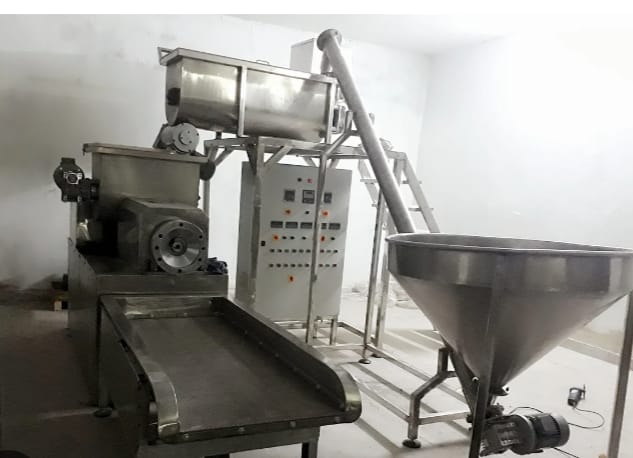
| Hopper | Stores and feeds the flour into the system. |
| Dosing Pump | Precisely controls the water-to-flour ratio. |
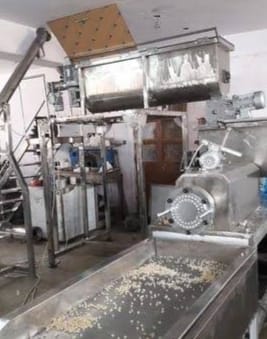
| Extrusion Barrel | The "heart" where pressure is built and dough is shaped. |
| PLC Control Panel | The digital brain that monitors temperature, pressure, and speed. |
| Pre-Dryer (Trabatto) | A vibrating screen that removes surface moisture immediately to prevent sticking. |
4. The Drying Stage: The Most Critical Step
A macaroni machine isn't just about the extruder; it’s about the Drying Tunnel. Fresh pasta has a moisture content of about 30%, but shelf-stable dry pasta must be reduced to about 12.5%.
Pre-Drying: The "Trabatto" uses hot air and vibration to "skin" the pasta so the pieces don't clump together.
Main Drying: This happens in stages. If you dry pasta too fast, it cracks (checking). If you dry it too slow, it can mold or sour.
Cooling: Before packaging, the pasta must be brought back to room temperature to prevent condensation inside the plastic bags.
5. Maintenance and Hygiene
Industrial pasta machines must adhere to strict food safety standards (like HACCP).
Stainless Steel Construction: All parts in contact with food are usually 304 or 316-grade stainless steel to prevent corrosion.
CIP (Clean-In-Place): Modern machines have automated cleaning cycles to ensure no old dough remains in the auger or die, which could harbor bacteria.
6. Choosing the Right Machine: Factors to Consider
If you are looking to invest in a macaroni production line, consider these three metrics:
Capacity: Machines are rated by kilograms per hour (kg/h). Small artisanal lines produce 30–50kg/h, while massive industrial lines can exceed 1000kg/h.
Versatility: Can the machine handle different flours (e.g., gluten-free, lentil flour, or whole wheat)? Some auger designs are better for "sticky" non-wheat flours than others.
Energy Efficiency: The drying stage is the most energy-intensive. Look for machines with high-quality insulation and heat recovery systems.
7. Trends in Pasta Machinery
The industry is currently moving toward Industry 4.0 integration. This means:
Remote Monitoring: Using an app to check the moisture levels in the drying tunnel.
Automated Shape Changes: Systems that allow for faster die swaps to minimize downtime.
Sustainability: Reducing water waste during the cleaning cycles and using electric drying instead of gas to lower the carbon footprint.
Summary
A Macaroni Pasta Making Machine is a sophisticated symphony of mechanical pressure and thermal control. By transforming simple flour and water into a perfectly shaped, shelf-stable product, these machines allow for the global distribution of one of the world's most beloved staple foods.