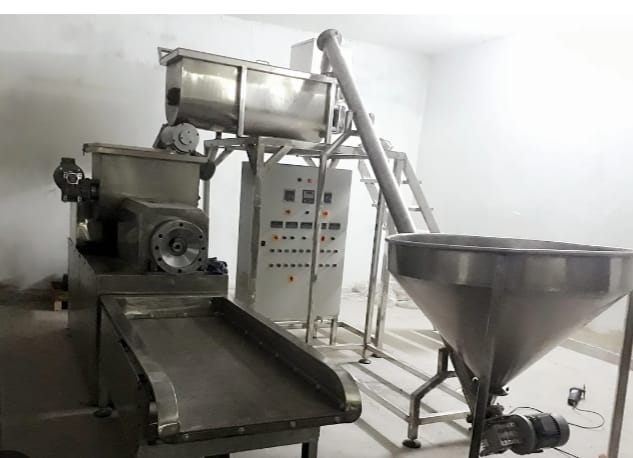


The production of macaroni and other pasta shapes has evolved from a labor-intensive kitchen craft into a highly sophisticated industrial process. A Macaroni Pasta Noodles Making Machine is the heart of this transformation, combining engineering precision with food science to deliver consistent, high-quality products.
Below is a comprehensive guide to understanding the technology, process, and components involved in modern pasta manufacturing.
1. Introduction to Pasta Extrusion Technology
At its core, a macaroni making machine is a Single-Screw or Twin-Screw Extruder. Unlike traditional cooking, where heat is applied externally to a pot, an extruder uses mechanical shear, pressure, and controlled heating to transform raw flour and water into a structured dough, which is then forced through a die to create specific shapes.
2. The Step-by-Step Production Process
To understand the machine, one must understand the journey of the ingredients.
A. Raw Material Mixing
The process begins with the dosing of Semolina (Durum wheat flour) and water. High-end machines often include a vacuum mixing chamber. By removing air during the mixing stage, the machine prevents the oxidation of pigments, resulting in a vibrant yellow color and a pasta "body" free of tiny air bubbles that could cause breakage during cooking.
B. Extrusion and Shaping
The dough is pushed forward by a high-torque screw. As it reaches the end of the barrel, it is forced through a Die.
The Die: This is a thick metal disc with precision-cut holes. If the holes are circular with a pin in the middle, you get macaroni or penne. If they are slits, you get fettuccine.
Teflon vs. Bronze Dies: Modern machines use Teflon-lined dies for a smooth, shiny finish, while premium "Artisan" machines use bronze dies to create a rough texture that helps sauce cling to the pasta.
C. Cutting
A high-speed rotating blade sits at the face of the die. By adjusting the speed of this blade, the operator determines the length of the pasta—short for macaroni or long for spaghetti.
D. Pre-Drying (Shaking)
Freshly extruded pasta is sticky. The machine moves the pasta onto a "shaker" or "vibrating pre-dryer" which uses hot air to flash-dry the surface, preventing the pieces from clumping together.
E. The Drying Cycle
This is the most critical part of the machine's job. Pasta must be dried slowly and evenly. If it dries too fast, it "checks" (develops internal cracks); if too slow, it can mold. Industrial lines use multi-stage drying tunnels where humidity and temperature are strictly controlled.
3. Key Components of the Machine
A standard industrial macaroni line consists of several integrated modules:
| Component | Function |
| Dosing System | Precisely measures flour and water ratios. |
| Vacuum Pump | Removes air from the dough for better texture and color. |
| Extrusion Barrel | Features a water-cooling jacket to prevent the dough from "cooking" prematurely due to friction. |
| PLC Control Panel | The "brain" of the machine, allowing operators to set screw speed, temperature, and cutting frequency. |
| Cooling System | Maintains a constant temperature in the extrusion head to protect protein structures. |
4. Technical Specifications to Consider
If you are evaluating a machine for purchase or study, these technical parameters are vital:
Production Capacity: Ranges from small-scale (25–50 kg/h) to massive industrial lines (1,000+ kg/h).
Power Consumption: Extruders require significant torque; a mid-sized machine may require 30kW to 60kW of power.
Material: To meet food safety standards, all parts in contact with food must be SUS304 Stainless Steel.
Expansion Ratio: The ability of the machine to handle different types of flour (rice flour, corn flour, or gluten-free blends).
5. Maintenance and Hygiene
Because pasta dough is a biological product, the machine must be designed for CIP (Clean-In-Place) or easy disassembly.
Die Cleaning: After a run, dies are often placed in ultrasonic cleaners to remove hardened dough from the intricate crevices.
Screw Removal: The main extrusion screw must be periodically pulled to inspect for wear, as any metal-on-metal contact could contaminate the food.
6. Modern Trends: Fortification and Innovation
Today's macaroni machines are doing more than just mixing flour and water.
Fortification: Many machines are now equipped with secondary injectors to add vitamins, minerals, or vegetable purees (spinach, beet) without breaking down the dough structure.
Gluten-Free Production: Special "Pre-gelatinization" extruders are used for gluten-free pasta. These machines use steam to partially cook the starch so it can hold its shape without the "glue" of gluten.
7. Summary of Advantages
Investing in a high-quality macaroni making machine provides:
Uniformity: Every piece of pasta is identical in weight and density.
Efficiency: Automated lines require minimal labor compared to manual extrusion.
Shelf Stability: Proper drying technology ensures the product can be stored for up to 24 months.